

ENVIRONMENT
It includes all living ( biotic) like human plants and non living ( abiotic ) like air, water, and soil etc.
NATURAL ENVIRONMENT
Natural environment means which can be made by nature on its own.
like rivers,climates,weather, etc.
COMPOSITION
Earth has 4 spheres
- Lithosphere
- Hydrosphere
- Atmosphere
- Biosphere
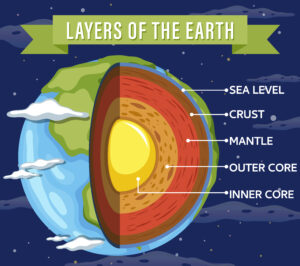
Earth has 6 layered structre
- Inner core
- outer core
- Lower mantle
- Upper mantle
- Lithosphere
- Crust
Geological activity
Lithosphere is outer surface of planet.
Water on earth
OCEANS
Ocean has saline water. 71% surface has been covered by water.
The Ocean: Earth’s Endless Blue Realm
The ocean is not just salty water—it is the beating heart of the hydrosphere. Covering nearly 71% of Earth’s surface (about 362 million square kilometers), it forms a continuous, shimmering expanse that we divide into great oceans and smaller seas. Yet beneath these divisions lies one interconnected body, often called the World Ocean or Global Ocean.
More than half of this watery domain plunges deeper than 3,000 meters (9,800 feet), hiding landscapes that remain among the least altered natural environments on our planet. Its average salinity hovers around 35 parts per thousand (3.5%), with most seawater ranging between 30–38 ppt—a delicate balance that sustains life across vast ecosystems.
Though we speak of separate oceans, their boundaries are drawn by continents, archipelagos, and shifting criteria. In descending order of size, they are:
– Pacific Ocean – the giant of giants
– Atlantic Ocean – the restless bridge between worlds
– Indian Ocean – warm and storied
– Southern Ocean – encircling Antarctica’s icy crown
– Arctic Ocean – the smallest, yet mysterious frontier
RIVERS
A river is more than moving water—it is a sculptor of landscapes. Its flow is usually confined within a channel, carved between banks and resting on a riverbed. Larger rivers often spill beyond their channels, creating vast floodplains—broad stretches of land shaped by overflow, sometimes many times wider than the river itself.
Rivers are an essential part of the hydrological cycle. Their waters gather from rainfall, surface runoff, groundwater recharge, springs, and the slow release of meltwater from glaciers and snow-capped mountains. Each drop carries the memory of its journey across Earth’s surface.
Smaller rivers wear many names—streams, creeks, brooks—but all share the same essence: a current bound by bed and banks. These flowing corridors act as lifelines, stitching together fragmented habitats and preserving biodiversity.
The study of these waters, their movements, and their mysteries is known as surface hydrology—a science that reads the language of rivers and streams, decoding how they shape both land and life.
LAKES
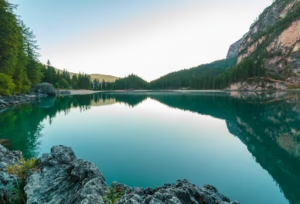 Natural lakes on Earth are rarely random—they tend to appear in dramatic landscapes: nestled among mountains, stretched along rift zones, or shimmering in valleys once carved by glaciers. Others emerge in endorheic basins, where rivers lose themselves without reaching the sea, or along the ghostly paths of ancient waterways.
In some regions, the chaotic drainage patterns left behind by the last Ice Age have scattered countless lakes like fragments of a broken mirror. Yet, in the grand sweep of geological time, every lake is fleeting. Slowly, they will be choked with silt or drained away as their basins surrender to the relentless reshaping of the planet.
Leave a Reply